Why Reading Physical Books Improves Memory Better Than Screens
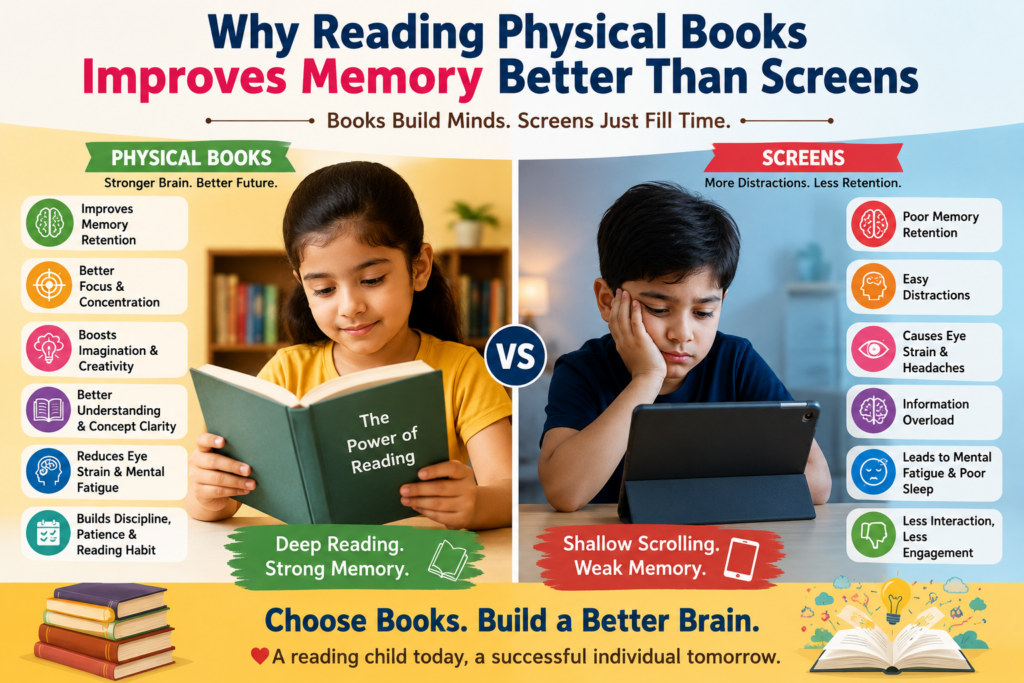
In today’s digital world, children are spending more time on screens than ever before. Tablets, mobile phones, and laptops have become a major part of learning and entertainment. While technology offers convenience, researchers and educators across the world still believe that physical books play a much stronger role in improving memory, concentration, and understanding.
But why does reading a real book feel different from reading on a screen?
Let’s understand.
1. Physical Books Improve Deep Focus
When children read from a printed book, their brain focuses on one task at a time. There are no notifications, pop-ups, advertisements, or distractions.
On screens, the brain often shifts rapidly from one thing to another. This habit reduces concentration power and weakens long-term memory.
Books train the brain to stay focused for longer periods — an essential skill for academic success.
2. Better Memory Retention
Studies have shown that students remember information better when they read from physical books instead of screens.
Why?
Because the brain creates a “mental map” of the content while reading a book. Children remember:
- where the topic appeared,
- how the page looked,
- and even the position of diagrams or paragraphs.
This physical interaction helps the brain store information more effectively.
3. Reading Books Reduces Eye Strain and Mental Fatigue
Excessive screen exposure can lead to:
- eye strain,
- headaches,
- disturbed sleep,
- and mental tiredness.
Printed books are naturally easier on the eyes and allow children to learn in a calmer and healthier way.
This is especially important during early childhood, when brain development happens rapidly.
4. Physical Books Build Stronger Imagination
Screens provide ready-made visuals and animations. Books, on the other hand, encourage children to imagine scenes, characters, and situations in their own minds.
This improves:
- creativity,
- thinking ability,
- visualization,
- and emotional intelligence.
Books make children active thinkers instead of passive viewers.
5. Better Understanding and Concept Clarity
Reading from books encourages slower and deeper learning. Students often understand concepts more clearly because they engage more actively with the content.
They can:
- underline points,
- make notes,
- highlight formulas,
- and revisit difficult sections easily.
This improves conceptual understanding — especially important for subjects like Mathematics, Science, History, and Grammar.
6. Books Help Develop Discipline and Patience
Reading physical books develops patience and consistency in children. Unlike quick-scrolling digital content, books require sustained attention.
This habit gradually improves:
- study discipline,
- memory power,
- reading habits,
- and academic confidence.
The Role of Parents
Children often imitate what they see around them.
If parents encourage reading habits at an early age, children naturally become more curious, focused, and academically strong.
Even reading for just 30 minutes daily can make a major difference in:
- vocabulary,
- concentration,
- imagination,
- and communication skills.
Final Thoughts
Technology is useful, but books remain timeless.
Physical books do much more than provide information — they shape thinking, improve memory, build imagination, and create stronger learners.
In a world full of distractions, books still offer one of the most powerful tools for deep learning and brain development.
So the next time your child picks up a book instead of a screen, remember — they are not just reading…
They are building their future.
Explore quality educational books and learning resources at:
https://arundeepselfhelp.info/